Sunday, 26 July 2015

Searing Heat

Escaping from LA 

Even on an early Sunday morning, leaving Los Angeles tests anyone's patience. I'm convinced LA has only two modes of traffic: heavy and heavier.

Eventually, I broke free from the congestion and found myself cruising down I-10, heading toward Palm Springs.

One of the most striking sights on the way to Palm Springs is the endless stretch of wind turbine farms dotting the valley. These massive structures go on for miles, harnessing the near-constant winds that rip through this area.

A word of caution if you ever visit: those turbines aren’t just for show. The wind here is intense. I forgot this fact and almost lost my car door when the wind tried to yank it clean off its hinges as I stepped out. Luckily, I caught it in time. For anyone under 100 pounds—or small children—stay buckled in unless you’re weighed down by a heavy bag or anchored to a sturdy object.

 
Wind Turbines Palm Springs, CA

Absolutely! The desert does have a captivating beauty, with its vast openness, dramatic landscapes, and those incredible sunsets—but living there is a whole different ballgame. It’s harsh, unforgiving, and relentless with that heat and dryness. Setting up an Airstream as a permanent home in that environment seems… ambitious, to say the least.

Maybe it’s the solitude or the simplicity that appeals to some. Or maybe they’re just drawn to the challenge of thriving in a place that seems determined to make it difficult. Who knows? The desert has a way of attracting unique souls who march to their own beat.

 
Airstream against the mountain. It's that tiny silver spec at the frames bottom.

This is rock falling country, why would anyone camp here?

I usually wouldn’t stop in Palm Springs, but I have a friend here: Gary Dorothy, a phenomenally talented photographer who owns Imageville. All the stunning work on display in his shop is shot and printed by Gary himself. If you ever pass through Palm Springs, drop by Imageville. It’s in the heart of town, surrounded by great bars and cafes. Tell him I sent you, and he’ll probably charge you 15% more! (On second thought, maybe don’t mention me.)
 
Gary Dorothy

Imageville

After saying goodbye to Palm Springs, I made a quick stop in Blythe, CA, for fuel and coffee. My car’s thermometer read 115°F, so I knew it was hot. But stepping outside? Searing heat is the only way to describe it. It’s the kind of heat that cooks you instantly, the kind that explains the blistered paint jobs on so many cars out here. This land doesn’t favor human beings—or much else.
 
115 Degrees F

Blistering paint


Continuing along Hwy 60, I was thrilled to stumble upon an abundance of ghost buildings and even an old pioneer cemetery on a road aptly named Ghost Town Road. There's something hauntingly beautiful about places like these—reminders of life that once thrived here, now claimed by time and the desert.
 
Ghost building

Where did all the people go?
Just had to find out what lay up this road

Wonder whatever happened to the horses that once hitched here

Pioneer Cemetery, check their spelling

Pioneer Grave
 
Reaching Prescott involved a slow, winding ascent through the Weaver and Bradshaw Mountains. The road is narrow and twisty, often limited to 25mph, which makes for slow going. Add in the irresistible need to stop for photos, and an hour-long drive easily doubles.

Prescott is a place where you’re quickly reminded that this is gun-packing country.

While checking into my motel, I found myself behind a sight I’ll not soon forget: a 5'2" bald guy wearing a “wife-beater” tank top, camouflage shorts, and flip-flops. Not so unusual for these parts—until I noticed the Glock 9mm strapped to his waist, complete with two spare clips. He was armed to the teeth, looking like he could take on the apocalypse.

Outside, his wife waited with their dog—a massive, mean-looking Boxer wearing a studded collar. The hound appeared to be gnawing on what might have been the remnants of a small animal. She was wearing a “husband-beater” shirt. The sight gave me second thoughts about asking them for a photo.

I suppose, in this part of the country, American Express’s slogan “Don’t leave home without it” might not just refer to a credit card.


More to come…

Saturday, 25 July 2015

Il est encore moi mes amis “Me Again”

Tomorrow I start my trip back to Markham. 

It’s been a fantastic 12 days in West Hollywood. I spent quality time with my daughter, Erinn, and her husband, Jesse, exploring the city and beyond.
 
Usually it's the guy who patiently waits while his wife shops for cloths

I walked the streets of West Hollywood, took a trip to Santa Barbara, and experienced the daily LA phenomenon known as “gridlock.” If you think Toronto’s traffic is bad, a day in LA’s bumper-to-bumper standstill will change your perspective. It’s no wonder California has the strictest auto pollution laws in the U.S.—though the well-worn Toyota pickups favored by local handymen and gardeners might be the exception.
 
 
The Best Bumper-to Bumper there is, and this isn't even rush hour.  No gaps between vehicles during rush hour.
 

LA Drivers are wild. Don't signal, and park wherever they please.
 
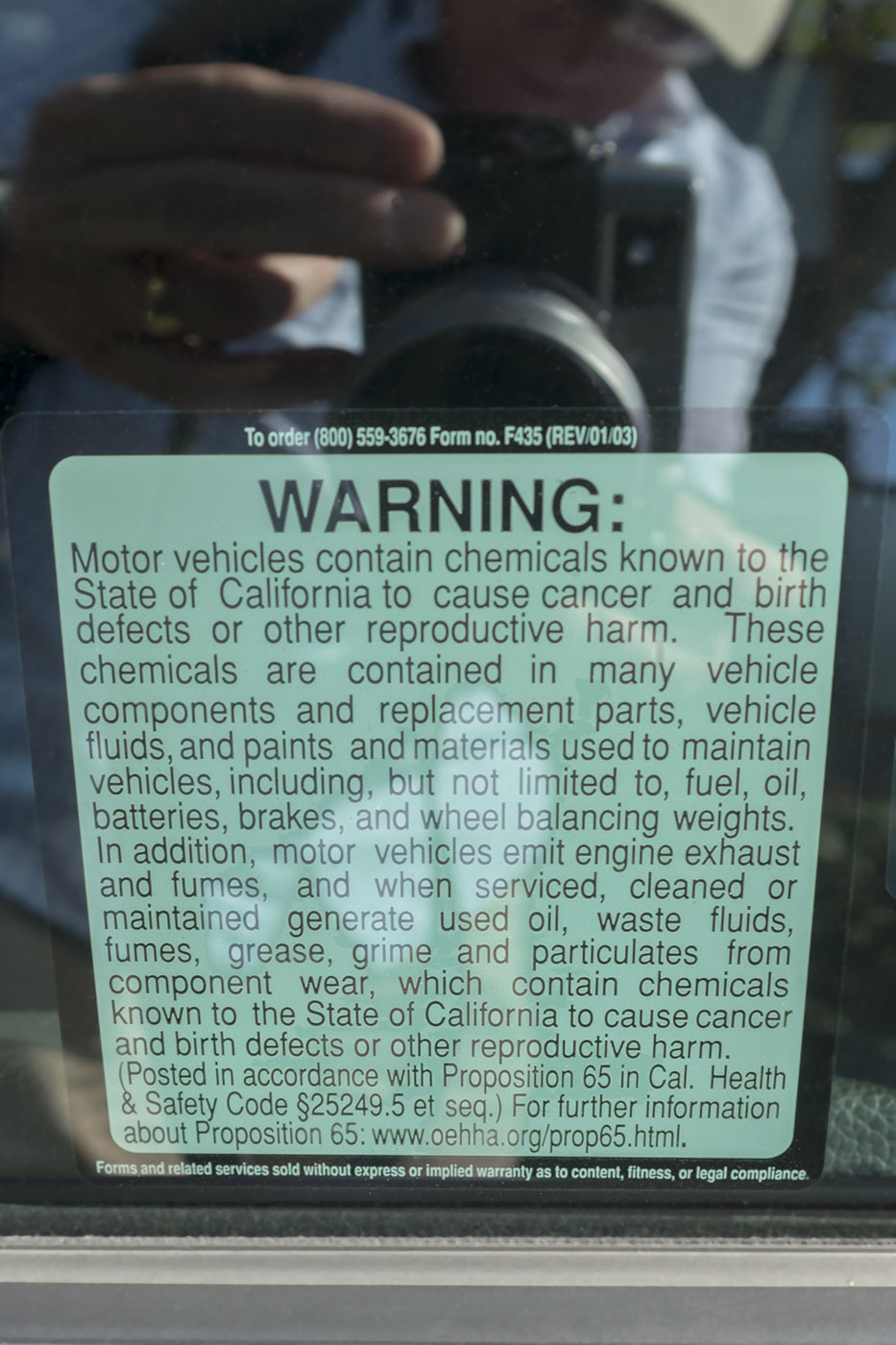
For a state that embodies the "don’t want government involved in my life" ethos, California has some of the strictest consumer protection laws in the country. Case in point: where else are car manufacturers required to warn buyers about every potentially harmful substance in their vehicles?
 
On the diver's side window of a new Ford.
 
Los Angeles truly is the city of dreamers—and broken dreams. I met many fascinating characters, each with a story to tell.

One particularly memorable encounter was with a woman I called “the Webster's Dictionary.” She wouldn’t share her name or let me photograph her face, but she was fine with me taking a picture of her reading material. She loves learning new words while reading, hence the dictionary. Watching the way others interacted with her was a study in human nature—indifference from most, but occasional moments of kindness from those who took the time to engage. The so-called “weird” ones often had the most captivating stories and welcomed a genuine conversation. None were aggressive, some just wanted to be left alone and others were real chatterboxes.

She loved to read and always wanted to know the meaning of words.

  Then there was Santiago—not “weird” in the slightest, just proud and determined. He came to the U.S. from Mexico at 13, got an education, held various jobs, and now works for himself. Every day, he waits outside the local Home Depot with other hopefuls, seeking work. Articulate, friendly, and brimming with pride, I asked if he had a business card and he held up his sign and told me to take a picture of it..
 
Santiago, advertising for work outside of Home Depot in LA

Santiago

I also crossed paths with Luc, who was painting a mural on the side of a Chinese restaurant. Despite being in a hurry, he graciously took the time to chat and pose for a photo.

Luc creating his art

In Santa Barbara, I met Philip, an artist who creates intricate sand sculptures. He works in the hope that passersby will drop a few coins in his plastic bucket.

Phil and his lady love on the beach at Santa Barbara
 
California is a diner’s paradise, with endless options for eating out. Even something as simple as pizza is elevated to gourmet status here.

Presentation is everything
 
One of LA's most famous and in-demand eateries is built around the lowly hot dog. Pink's is in its 75th year of continuous operation.

For the past 75 years they've come from all over LA to line up in the heat

Jesse and Erinn waiting in line at Pink's

Like a ballet they spin, swirl, duck and out comes the food
 
Then there are the more formal casual dining places.

Fine casual dining LA style

Nothing like having lunch with a few friends.

Friends joining in for lunch

Los Angeles is undeniably a city of extremes. The divide between the haves and have-nots is glaringly obvious. It’s also a city overflowing with plastic surgeons, health food stores, gyms, beautiful people, and therapists. One sign I saw seemed to encapsulate it all perfectly.
 
So true

Speaking of over-the-top, I came across a promotional billboard boasting massive photos supposedly taken on a cell phone. I couldn’t help but wonder, this being Hollywood and Hollywood being Hollywood, if this wasn't just another movie set façade.

Images made with iPhone 6 or so Apple claims

A local told me there’s a stretch of Route 66 where the rumble strip plays “America the Beautiful” when driven over. I didn’t encounter this myself, but it left me pondering—if you drove the strip in reverse, would it play the song backward? Just a thought.

My return journey won’t retrace Route 66. Instead, I’ll head east to Palm Springs, then swing northeast to Jerome, AZ, onto Flagstaff, and further north to Page, AZ. From there, I’ll backtrack slightly and climb up to Mexican Hat, UT, and Moab, UT, before finally joining I-70 in Colorado for the eastward trek home to Markham. The trip back should take about five days—though with this adventure, who can say for sure?

I’ll try to blog regularly, but forgive me if I miss a day or two. This journey has been extraordinary, and I look forward to what’s still to come.

More to come…

Wednesday, 15 July 2015

The lights of LA or How Bandits Held Me Up in the Black Mountains.

Finally, the bright lights of Hollywood are in the distance. 

Eight days, 4,781 miles, 10 gas fill-ups (some partial), six car washes, and countless images—what a journey.

I’ve traveled mile after mile of roads that varied from well-paved highways to dusty, dirt (and often clay) paths. I’ve learned about the addictive allure of the 32oz/79¢ Diet Coke (a dangerous companion) and discovered that McDonald’s offers not only some of the best road coffee but also free Wi-Fi at nearly every location. Oh, and the curious McDonald’s cashiers apologizing for their $1, 32oz-only soft drinks was a cultural quirk I’ll always remember. Despite my best efforts, I kept asking for a medium.

This last leg westward brought me to some fascinating places.

I left Kingman, AZ, heading toward Oatman, nestled high in the Black Mountains—yes, along Route 66. Maps can be deceiving, showing distances that seem manageable in a few hours, but the vast, open desert stretches time in ways you don’t anticipate.

Typical Dirt Road

The desert road was endless—dusty, hot, and captivating. At one point, my car’s temperature gauge read 117°F (47.2C). Stepping out of the car felt like opening an oven door while cooking a holiday turkey—the wave of heat almost knocked me over.
 
Hot, Hot, Hot

Desert Beauty

Arizona's version of our super mailbox

But there’s a silver lining to the heat: slower speeds allowed me to absorb more of the desert’s unique beauty. Free from the clutter of billboards, the landscape was stunning in its simplicity. I stopped countless times, despite the heat, just to soak it all in. It’s also rattlesnake country, and yes, I encountered a few. Dass would love it here!

The climb toward Oatman was steep and winding, with my GPS resembling a bowl of spaghetti—a series of sharp switchbacks, narrow roads, and steep drops with no guardrails. I passed just one establishment, Cool Springs, on the road from Kingman to Oatman, but unfortunately, it was closed.

An Oasis but the door was locked. Sure hope passerbys had their own water.

The Desert Consumer All

 
The GPS and the Mountain Road
 
When I arrived in Oatman, I initially thought it was just another cluster of old, deserted buildings. I was wrong. Rounding the bend, I stumbled onto what can only be described as “Hollywood in the Hills.”
 
Not What I was Expecting
 
Oatman is a full-fledged tourist trap, but in the best way. The buildings are original and well-preserved, and the star attractions are the “town donkeys.” These gentle creatures roam the streets freely, eagerly accepting food from tourists. It’s definitely worth a visit, but be warned—it’s dangerously hot even at 5,568 feet above sea level.

Leaving Oatman, I began the descent toward Topock. Just outside town, I had an unexpected run-in with some “local bandits.”  Even the mountains have their dangers not, just the big cities.  
 
First the Road Block

Then the Approach

Then the Demand

No six-shooters were involved, but these highway robbers—wild donkeys—had a well-organized plan. One would wander into the road to stop cars, while others checked for food. One even stuck its head into my car looking for snacks, while another helped itself to a bag of chips from the SUV ahead of me. It was equal parts hilarious and memorable.   
 
 Topock, is a stark contrast to Oatman, in a blink-and-you’ll-miss-it kind of place. Essentially just a bend in the road under a railway underpass, its only real claim to fame is that it marks the Arizona-California state line.
 
Topock

Topock

Crossing into California brought me to the chaos of the LA freeway system during rush hour. Compared to Toronto’s rush hour, this felt like a demolition derby. I’m convinced that turn signals are an optional accessory on California cars, as no one seemed to use them. With one hand on their cell phone and the other gripping a 32oz drink, drivers weaved across three or four lanes of traffic at breakneck speeds. Once I got the hang of it, I’ll admit—it was kind of fun.

I’ll be in LA for the next seven to ten days before starting the drive back. This time, I won’t retrace Route 66 but will instead head through the Bradshaw Mountains to Sedona, then north to Flagstaff, Page, and Monument Valley, before joining I-70 and heading eastward.

Blogging every night has been time-consuming, so don’t be surprised if I post less frequently on the return trip.

This is truly a majestic country, and it’s worth exploring every corner of it.


More to come (maybe)…

Tuesday, 14 July 2015

The End is Near But Still Things to See

Almost glad to be leaving Gallup behind.  

Not that there's anything wrong with Gallup, but the ordeal of getting there from the VLA is one I’d rather leave in the rearview mirror.

Crossing into Arizona filled me with hope. The promise of small towns—or at least their remnants—was enticing. First up was Lupton, but that hope quickly started to fade. To put it kindly, Lupton was mostly a collection of tourist traps where locals sell their wares, many of which had that unmistakable “made in China” look. The parking lot was packed with cars sporting license plates from all over the country. Thankfully, my mud-caked car made it impossible to tell where I was from. As P.T. Barnum once said, “There’s a sucker born every minute,” and the enterprising Navajo vendors seem to have fully embraced his philosophy.

Trying to be incognito

Further along, I arrived in Allentown and stumbled upon an abandoned section of Route 66—what I like to call a “broken link.” 
 
This stretch of the road was severed from the main route about a mile east of town, leaving it accessible but hidden behind the “Trading Post.” The road is incredibly narrow—about 9 feet wide—and along it, I discovered a charming old house and met Chaney, a 90-year-old Navajo woman. She lives at the end of the road and walks into Allentown daily. She was delightful to chat with, but she refused to have her picture taken. I know what you’re thinking—why not just take it when she wasn’t looking? One of my rules is to always ask permission, and if someone says “no,” I respect their wishes. Even without a photo, Chaney left a vivid impression.
 
Chaney's road. About 9 ft wide.

Old House near Allentown. 

Leaving Allentown, I found Route 66 flooded out and had to backtrack to I-40. I rejoined the route at Chambers, a town notable only for its post office and a few abandoned buildings.

Old House with Dead Tree at Chambers


Chambers Gas Station. Lives up to the first part of it's name.

Next was Holbrook, where I met Joseph of the Santo Domingo tribe. He was quite the character and had no qualms about having his photo taken—in fact, he seemed thrilled about it.
 
Joseph

Came to Joseph City, no relation to Joseph of Holbrook. 

Afterward, I stopped in Joseph City. Why it’s called a city is beyond me—it’s more like a hamlet. Main Street (the only street, really) features several abandoned buildings, but not much else.
     
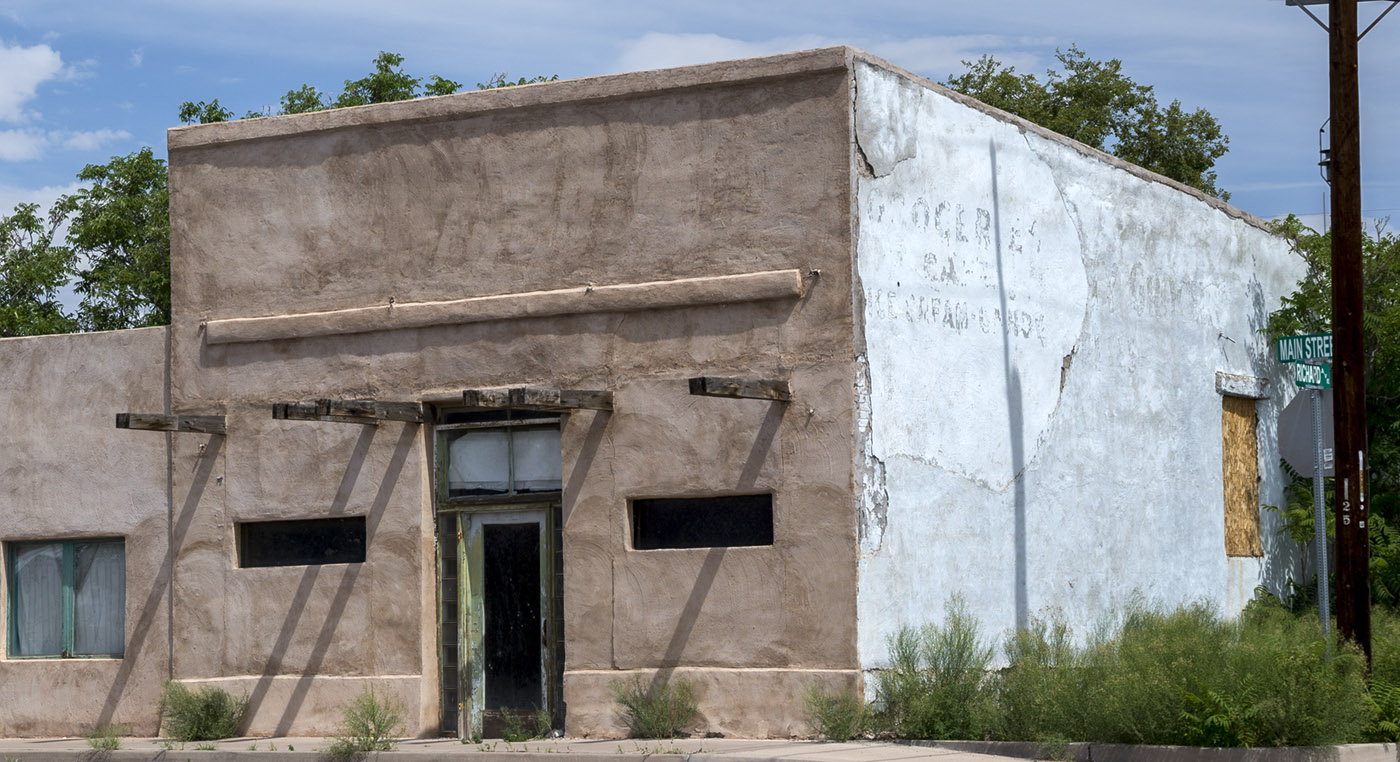
Adobe style in Joseph City

Then came Two Guns. Yes, that’s the actual name. This place made my day. Its claim to fame dates back to around 1881, and the town was built on the edge of Canyon Diablo. When I pulled into what remains of the gas station, I noticed someone actually waiting for service. I thought about telling them the place was closed but figured it wasn’t worth the effort as it would probably just fall on deaf ears.

Should someone tell it the garage is closed

Where have all the people gone?

The Wild Animals were kept here on display. Not kidding, they actually had wild critters on view.
My last stop for the day was Seligman, just off I-40 and about an hour west of Flagstaff. Now, this is a Route 66 town that’s managed to keep the buzz alive.

Not all Route 66 towns dried up and died.  Seligman sure didn't

The drive from Seligman to Kingman was beautiful. Along the way, I passed through Hackberry, home to the quirky and fascinating “Hackberry General Store.” It’s a treasure trove of curiosities, from bleached cow skulls to vintage Model T-era cars. Even though the place wasn’t technically open, it’s a must-stop for anyone passing by.
 
Road to Kingman
Hackberry Geneal Store

Tomorrow marks the final stretch of my journey to Los Angeles.

More to come...